Humanizing Student Affairs Dashboards: From “Show Me the Data” to “Show Me the Students”
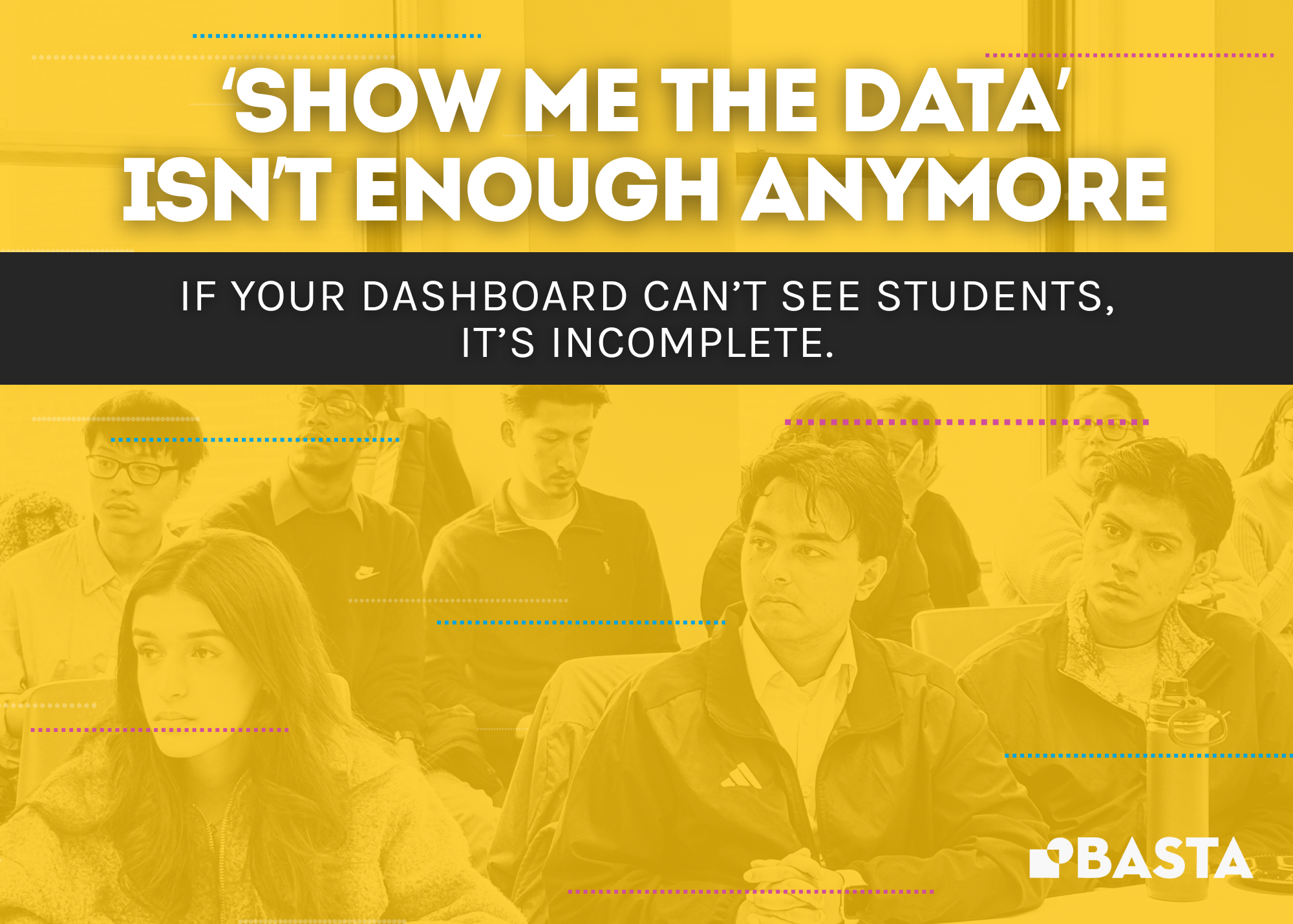
Data tells us what is happening; human-centered insights tell us why.
Across higher education, one truth keeps resurfacing: student affairs teams are doing more work with fewer resources, and with higher expectations than ever before.
Institutional leaders want real-time clarity on what’s working — and what isn’t — as career outcomes become central to campus strategy. While students want personalized support, student affairs staff want something that is hard to achieve: the time and space to do high impact work.
None of this is changing soon, as the pressure to connect college inputs to life outcomes is only going to intensify:
46% of U.S. adults question the value of a college degree (Gallup–Lumina, 2025).
52% of recent graduates are underemployed one year after finishing college. (Strada Talent Disrupted, 2024).
73% of college graduates who start out underemployed remain so a decade after graduation, resulting in lifetime earnings penalties of up to $1.5M according to Burning Glass Institute.
Institutions are being asked to demonstrate impact with real-time data — not end-of-year reports.
The competitiveness of our current job market means students can expect to submit 15–25 job applications per offer (Handshake, 2023). In more competitive early-career tracks, it’s even higher: 247 per tech internship, for example.
Amid this pressure, campus leaders tell us the same thing: they don’t just need more data, they need the right data — like “How close are my students to finding real jobs?” and “What drives them?” — so they can design better programs, make the case for resources, and avoid starting from scratch with every student. That’s where responsive dashboards and AI-enabled career navigation, used responsibly and humanely, can change the equation.
The ROI Debate Isn’t (Just) About Money — It’s About Alignment on Impact
When we talk about ROI in student affairs, the conversation often jumps straight to budgets, efficiency, and cost per student. But the real heart of ROI is impact.
Are students landing strong first jobs that steer them away from long-term underemployment?
Are they building the right networks and confidence?
Are interventions reaching the students who need them most, at the moments they need them most?
So the core question isn’t “What does this program cost?” It’s: “Does this increase a student’s first salary and long‑term economic mobility?”
Useful dashboards help campuses see the student experience clearly, without chasing data across spreadsheets, systems, and staff memories — and align investments with the impact that truly counts.
What Responsive Dashboards Make Possible
Across our 100+ partners, three themes show up again and again.
1. Dashboards shift teams from reactive to proactive
Student affairs teams spend enormous time tracking who showed up for interviews, who submitted applications, and who failed to follow-up. Dashboards automate this administrative burden, allowing teams to focus on high impact advising work and surfacing gaps. With the right context, decisions also get faster and better. One partner put it this way:
“This (dashboard) provides the baseline we need to guide advising, advocate for change, and better support students. It’s incredibly helpful data for our counselors.”
2. Cross-department collaboration, one shared language
Career services, advising, college success coaching, student life, and academic departments often operate in silos, rarely sharing a common view of progress.
Responsive dashboards give leaders a shared language across units, connecting engagement, career readiness, persistence and jobs applications.
“When we can view session satisfaction and job board usage in one place, we see how small tweaks to sessions boost students’ confidence and their likelihood of applying — and how those pieces work together to drive impact.” — Maggie Raible, Head of Impact & Experience, Basta
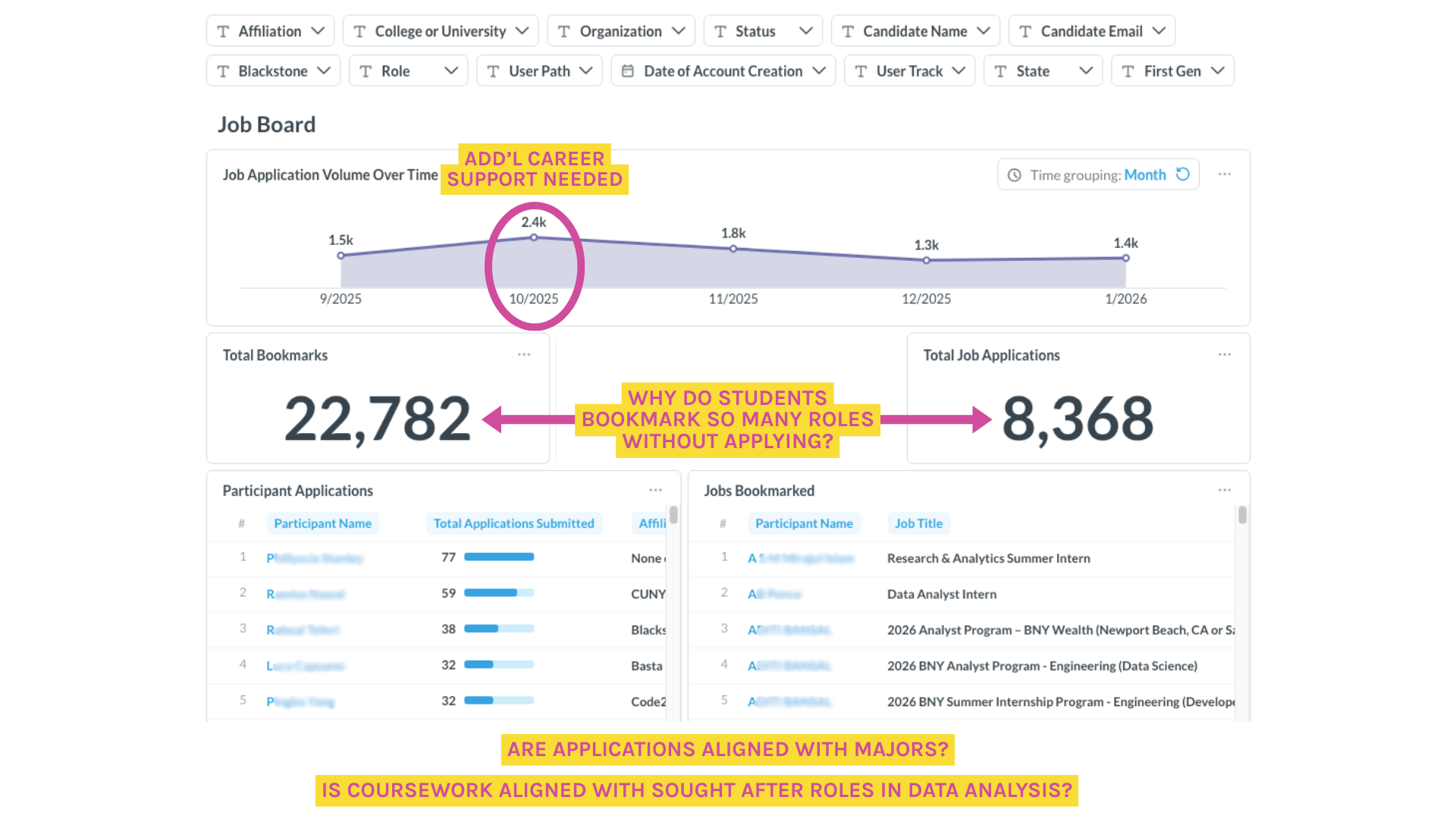
Using real-time career navigation dashboards to surface critical questions about interventions.
3. Dashboards make ROI storytelling easier — and more human
With all the data in one place, dashboards become a starting point for asking better questions about overall campus performance. Student affairs leaders can tell stories like:
Which students engaged early, and how did that affect persistence and academic momentum?
Which milestones correlate with internships or job offers?
Importantly, they can highlight qualitative wins too — the moments of connection, mentoring, and care that matter most but often go unseen. When done right, dashboards don’t reduce students to numbers, they illuminate the human work behind the metrics.
Where Technology Actually Eases Burnout
Technology should never replace human work, it should make it sustainable. Used responsibly, technology can reduce administrative and logistical work that fuels burnout by:
Parsing job descriptions quickly to deliver personalized job recommendations
Highlighting mismatches between student pathways and employer needs to reduce applications-to-interview ratios
Taking on time-consuming tasks like caseload intake
Efficiency is not the endgame; enabling advisors to reinvest their energy in students and their success is.
👉 CONTACT US TODAY to learn more about career navigation dashboards.
What Higher Ed Leaders Can Do Next
If you’re a Vice President of Student Affairs, Dean, or Director wondering how to move from data to impact, here are four steps that can make a difference:
1. Start with one question: What do we wish we could see, but can’t?
That becomes your dashboard blueprint.
2. Build cross-department alignment early.
Success happens when advising, career services, student life, and academic affairs co-own the insights and the impact.
3. Use AI where it expands breathing room — not where it replaces judgment.
AI should simplify the work, not define it.
4. Tell student stories alongside student data.
The campuses with the clearest ROI story pair numbers with narratives. Behind every data point, there is a human story to be told.
Want to Bring These Tools to Your Campus?
We partner with campuses across the U.S. to help students land strong internships and first jobs.
